
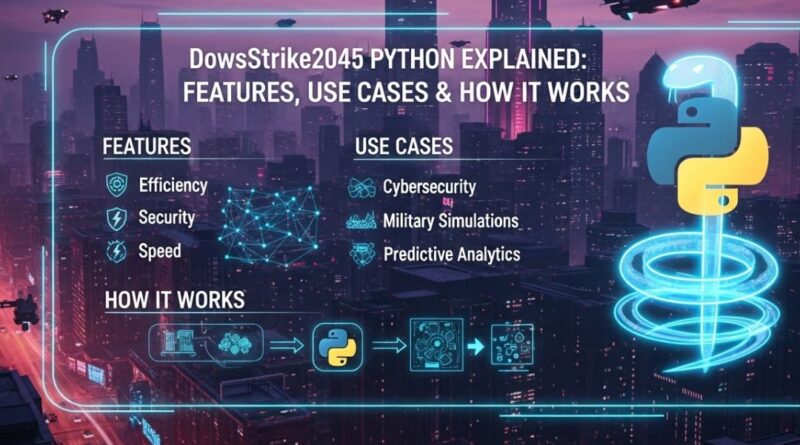
DowsStrike2045 Python: Features Use Cases & How It Works
In the rapidly evolving landscape of cybersecurity and penetration testing, specialized tools have become essential for security professionals who need to assess network vulnerabilities and protect digital infrastructure. DowsStrike2045 Python has emerged as a discussion point among developers and security researchers exploring advanced network analysis capabilities. This comprehensive guide examines what DowsStrike2045 Python represents, its potential applications, technical architecture, and how it fits within the broader ecosystem of security testing frameworks. Whether you’re a cybersecurity professional, Python developer, or technology enthusiast, understanding these concepts will help you navigate the complex world of network security tools.
What Is DowsStrike2045 Python?
DowsStrike2045 Python represents a conceptual framework or potential tool within the Python programming ecosystem designed for network security analysis and penetration testing operations. While specific documentation may vary, the name suggests a specialized utility that leverages Python’s extensive libraries for conducting security assessments. Python has become the go-to language for security professionals due to its readability, extensive library support, and rapid development capabilities.
The designation “2045” could indicate a version number, release year reference, or project code name that distinguishes this particular implementation from other security frameworks. Security tools often use unique identifiers to differentiate between various iterations and feature sets.
Python-based security frameworks have revolutionized how professionals approach vulnerability assessment. They offer flexibility that compiled languages cannot match while maintaining sufficient performance for most security testing scenarios. The DowsStrike2045 Python framework likely builds upon this foundation to deliver specialized functionality.
Core Features of DowsStrike2045 Python
Network Reconnaissance Capabilities
Network reconnaissance forms the foundation of any security assessment. DowsStrike2045 Python potentially incorporates modules that enable security professionals to map network topologies, identify active hosts, and enumerate services running on target systems. These capabilities typically utilize Python libraries such as Scapy for packet manipulation and analysis.
Effective reconnaissance tools provide multiple scanning techniques to avoid detection by intrusion prevention systems. This includes TCP connect scans, SYN stealth scans, and UDP service discovery. The framework may implement rate limiting and randomization features to make scanning activities less conspicuous.
Port scanning functionality allows testers to identify which network services are accessible on target systems. This information proves invaluable when assessing potential attack surfaces and security postures. Modern scanning implementations must balance speed with stealth to conduct thorough assessments without triggering security alerts.
Vulnerability Detection Mechanisms
Identifying security weaknesses represents a critical function of any penetration testing framework. DowsStrike2045 Python may include vulnerability scanning capabilities that check for known security issues across different protocols and services. These mechanisms compare service versions against vulnerability databases to flag potentially exploitable weaknesses.
Automated vulnerability detection saves countless hours compared to manual assessment techniques. However, experienced security professionals know that automated tools should complement rather than replace human expertise. False positives remain a challenge in vulnerability scanning, requiring verification before remediation efforts begin.
The framework might integrate with common vulnerability databases like CVE (Common Vulnerabilities and Exposures) to maintain current threat intelligence. Regular updates ensure the tool remains effective against newly discovered security issues.
Exploitation Framework Integration
Security testing often requires the ability to validate discovered vulnerabilities through controlled exploitation. DowsStrike2045 Python could provide integration points with popular exploitation frameworks or include its own exploit modules for common security weaknesses.
Exploitation capabilities must be used responsibly and only within authorized testing environments. Ethical hackers and penetration testers operate under strict rules of engagement that define acceptable testing parameters. Unauthorized exploitation activities constitute criminal offenses in virtually all jurisdictions.
Modern exploitation frameworks include safety features that prevent accidental system damage during testing. These safeguards help ensure security assessments improve rather than compromise organizational security postures.
Technical Architecture and Implementation
Python Library Dependencies
Python’s strength lies in its extensive ecosystem of third-party libraries. DowsStrike2045 Python likely depends on several established packages that provide networking, cryptography, and data processing capabilities. Common dependencies for security tools include requests for HTTP operations, paramiko for SSH connections, and cryptography for encryption functions.
Managing dependencies effectively ensures tool stability and security. Outdated libraries may contain vulnerabilities that could compromise the security tool itself. Responsible developers maintain current dependency versions while testing for compatibility issues.
Virtual environments allow developers to isolate project dependencies and avoid conflicts between different Python applications. This practice has become standard in professional Python development and proves particularly important for security tools that may require specific library versions.
Modular Design Philosophy
Well-designed security frameworks embrace modularity, allowing users to load only the components they need for specific tasks. DowsStrike2045 Python might implement a plugin architecture that supports custom modules and extensions. This approach enables the security community to contribute additional functionality without modifying core framework code.
Modular designs facilitate maintenance and troubleshooting by isolating functionality into discrete components. When issues arise, developers can focus on specific modules rather than analyzing entire codebases. This separation of concerns represents a fundamental principle in software engineering.
The framework likely provides clear interfaces between modules, enabling interoperability while maintaining code independence. These interfaces define how different components communicate and share data throughout the testing workflow.
Practical Use Cases for Security Professionals
Penetration Testing Engagements
Penetration testers regularly assess organizational security by simulating real-world attack scenarios. DowsStrike2045 Python could serve as a valuable tool during various testing phases, from initial reconnaissance through post-exploitation activities. Professional testers often assemble custom toolkits combining multiple utilities to address diverse client environments.
Different industries face unique security challenges requiring specialized testing approaches. Financial institutions prioritize data confidentiality and transaction integrity, while healthcare organizations focus on protecting patient information and ensuring system availability. Flexible frameworks adapt to these varied requirements.
Comprehensive penetration testing reports document discovered vulnerabilities, successful exploitation attempts, and remediation recommendations. Quality reporting transforms technical findings into actionable business intelligence that drives security improvements.
Red Team Operations
Red team exercises involve adversary simulation designed to test organizational detection and response capabilities. These operations typically extend beyond technical exploitation to include social engineering, physical security testing, and persistent access techniques. DowsStrike2045 Python might support red team objectives through stealthy reconnaissance and lateral movement capabilities.
Successful red team operations require coordination between offensive security personnel and defensive blue teams. These exercises provide invaluable insights into security program effectiveness and incident response procedures. Organizations learn more from realistic attack simulations than from theoretical security assessments.
Metrics from red team engagements help quantify security program maturity and guide resource allocation decisions. Leadership teams need concrete data demonstrating security investment returns and identifying areas requiring additional attention.
Security Research and Education
Academic researchers and security trainers utilize practical tools to explore vulnerability mechanisms and develop new defensive techniques. DowsStrike2045 Python could support educational initiatives by providing hands-on experience with real security concepts. Learning security principles through practical application proves more effective than purely theoretical instruction.
Cybersecurity education faces growing demand as organizations struggle to fill security positions. Practical training tools help develop the next generation of security professionals who will defend against increasingly sophisticated threats. Universities and training organizations continuously seek effective educational resources.
Responsible disclosure practices govern how security researchers handle newly discovered vulnerabilities. Researchers typically notify affected vendors privately before publishing details publicly, allowing time for patch development and distribution.
Installation and Configuration Guidelines
System Requirements
Running security tools requires adequate computing resources and compatible operating systems. DowsStrike2045 Python likely runs on major operating systems including Linux distributions, macOS, and Windows. Linux environments, particularly Kali Linux and Parrot Security OS, provide optimized platforms for security testing with pre-configured tools and libraries.
Minimum hardware requirements typically include sufficient RAM for handling network data and processing scan results. Storage requirements depend on logging verbosity and result retention policies. Professional security operations often utilize dedicated testing systems isolated from production networks.
Network connectivity considerations include the ability to route traffic appropriately and avoid interference with operational systems. Many organizations establish dedicated testing networks that mirror production environments without risking service disruption.
Initial Setup Process
Installing Python-based security tools generally involves cloning source repositories, installing dependencies, and configuring operational parameters. Package managers like pip simplify dependency installation by automatically resolving library requirements. Security-conscious users verify package signatures and checksums before installation to prevent supply chain compromises.
Configuration files typically define default behaviors, target specifications, and output formats. Well-documented tools provide clear configuration examples and explain available options. Proper configuration ensures tools operate as intended and generate useful results.
Testing installations in controlled environments before operational use prevents unexpected behaviors during critical assessments. Validation procedures confirm that all modules function correctly and produce expected outputs.
Best Practices for Responsible Usage
Legal and Ethical Considerations
Security testing must operate within legal boundaries and ethical frameworks. Unauthorized access to computer systems violates laws worldwide, regardless of intent. Professional penetration testers obtain explicit written authorization before conducting any testing activities. These agreements specify testing scope, acceptable techniques, and coordination procedures.
Computer Fraud and Abuse Act (CFAA) in the United States and similar legislation internationally criminalize unauthorized computer access. Violations carry severe penalties including imprisonment and substantial fines. Security professionals maintain strict compliance with applicable laws and regulations.
Ethical hacking certifications like CEH (Certified Ethical Hacker) and OSCP (Offensive Security Certified Professional) emphasize legal and ethical responsibilities alongside technical skills. These programs prepare practitioners for professional security careers grounded in responsible practices.
Operational Security Measures
Security tools themselves represent potential security risks if compromised or misused. Protecting tool access through strong authentication prevents unauthorized usage. Encrypted storage safeguards sensitive configuration data and assessment results from disclosure.
Logging and auditing tool usage creates accountability and supports incident investigation if security events occur. Organizations should monitor security tool deployment and usage patterns to detect anomalous activities that might indicate compromise or misuse.
Regular updates maintain tool effectiveness against evolving threats while patching security vulnerabilities in the tools themselves. Automated update mechanisms reduce administrative burden while ensuring current protection levels.
Integration with Existing Security Workflows
Complementary Tools and Frameworks
No single tool addresses all security testing requirements. DowsStrike2045 Python likely works alongside other established frameworks like Metasploit, Burp Suite, and Nmap to provide comprehensive assessment capabilities. Skilled practitioners leverage multiple tools strategically, selecting appropriate utilities for specific tasks.
Workflow automation connects different tools through scripting and API integration, streamlining repetitive tasks and improving efficiency. Python’s scripting capabilities make it ideal for creating custom automation that orchestrates multiple security tools.
Data exchange between tools requires standardized formats that preserve information integrity. Common formats include JSON for structured data and CSV for tabular results. Standardization facilitates analysis and reporting across tool boundaries.
Reporting and Documentation
Effective security assessments produce actionable reports that communicate findings to technical and executive audiences. Automated reporting features transform raw scan data into professional documentation highlighting critical vulnerabilities and recommended remediation steps.
Executive summaries distill technical findings into business impact statements that support decision-making. Technical appendices provide detailed information that engineers need for remediation activities. Balancing these perspectives ensures reports serve multiple stakeholder needs.
Tracking remediation progress through follow-up assessments demonstrates security program effectiveness. Comparative reports show vulnerability trends over time, indicating whether security postures improve or deteriorate.
Performance Optimization Strategies
Scanning Efficiency Techniques
Large-scale security assessments generate substantial network traffic and processing demands. Optimizing scan parameters balances thoroughness with resource consumption. Parallel processing techniques distribute workloads across multiple threads or systems, reducing total assessment time.
Target prioritization focuses resources on high-value assets and likely vulnerability locations. Risk-based approaches recognize that exhaustive testing of every system may be impractical in large environments. Strategic testing delivers maximum value within resource constraints.
Caching mechanisms avoid redundant operations by storing and reusing previous results where appropriate. This optimization proves particularly valuable during iterative testing cycles that repeatedly assess similar targets.
Resource Management
Memory management becomes critical when processing large datasets from extensive network scans. Python’s garbage collection handles most memory cleanup automatically, but developers must avoid memory leaks in long-running operations. Efficient data structures minimize memory footprints while maintaining necessary information.
CPU utilization monitoring identifies performance bottlenecks that limit assessment speed. Profiling tools reveal which operations consume the most processing time, guiding optimization efforts. Sometimes algorithmic improvements provide greater benefits than hardware upgrades.
Network bandwidth management prevents testing activities from overwhelming network infrastructure. Rate limiting and traffic shaping ensure security assessments don’t inadvertently create denial-of-service conditions.
Future Developments and Community Contribution
Evolving Threat Landscape
Cybersecurity threats continuously evolve as attackers develop new techniques and exploit emerging technologies. Security tools must adapt accordingly to remain effective. Cloud computing, containerization, and Internet of Things devices introduce new attack surfaces requiring specialized testing approaches.
Artificial intelligence and machine learning increasingly influence both offensive and defensive security capabilities. Adaptive tools that learn from previous assessments may provide more effective future security testing. However, these advanced capabilities also raise new ethical considerations.
International cooperation among security researchers accelerates tool development and threat intelligence sharing. Open source security projects benefit from global contributor communities that bring diverse perspectives and expertise.
Contributing to Open Source Security
Many security frameworks operate as open source projects that welcome community contributions. Developers can submit bug fixes, new features, and documentation improvements that benefit the entire security community. Contributing to established projects provides learning opportunities while building professional portfolios.
Responsible disclosure practices apply to security tools themselves when contributors discover vulnerabilities. Project maintainers appreciate private notification that allows fixing issues before public disclosure. This collaborative approach strengthens overall security ecosystem integrity.
Code review processes maintain quality standards and prevent malicious contributions from compromising tool integrity. Established projects implement multi-step review procedures before merging community submissions.
Conclusion
DowsStrike2045 Python represents the ongoing evolution of Python-based security testing frameworks that empower professionals to assess and improve organizational security postures. Understanding these tools, their capabilities, and responsible usage practices proves essential for anyone involved in cybersecurity operations. The framework potentially offers valuable features for network reconnaissance, vulnerability detection, and security validation when used within appropriate legal and ethical boundaries.
Security professionals must balance technical capabilities with legal compliance and ethical responsibility. Proper authorization, careful planning, and thorough documentation separate legitimate security testing from criminal hacking activities. As cyber threats continue growing in sophistication and frequency, tools like DowsStrike2045 Python provide necessary capabilities for defending digital assets and infrastructure.
The future of cybersecurity depends on collaborative efforts between tool developers, security practitioners, and organizational leadership. By embracing best practices, maintaining current knowledge, and contributing to community advancement, security professionals can build more resilient defenses against evolving threats. Whether you’re conducting penetration tests, performing security research, or learning cybersecurity fundamentals, understanding frameworks like DowsStrike2045 Python enhances your ability to protect digital environments effectively.
If you’re interested in exploring network security testing capabilities, start by establishing proper lab environments, obtaining necessary authorizations, and connecting with professional security communities. Responsible security practice begins with education, continues through ethical application, and contributes to a safer digital ecosystem for everyone.